TOOLS
Making thermal ecology open & accessible
The mission of the TrEnCh project is to create and share tools that empower people to predict climate change responses and visualize data. Here you can find all of the tools and products we have created so far! All code is available at our GitHub organization and we welcome contributors.
Featured tool
TrenchR
An R package for environmental and ecological biophysics, TrenchR offers microclimate models as well as accessible energy budget models to translate microclimate into estimates of animal body temperature. The package is available on CRAN and described in this paper.
We offer an interactive visualization for aiding the selection of microclimate data. Once microcliamte data are selected, we offer a user's guide for accessing the data.
TrenchR is complementary to the NicheMapR initiative, which offers an R package and RShiny interfaces for more complex microclimate and biophysical models. The package is also complementary to the MICROCLIM, which offers tools and data for microclimate modelling.
Explore TrenchR
Education and outreach
TrEnCh-Ed
We have created the TrEnCh-ed website, including interactive R Shiny applications and associated tutorials, to allow students and visitors to explore the ecological and evolutionary impacts of climate change through interacting with data.
Explore TrEnCh-Ed
Biophysical ecology tutorials
We’ve developed a series of tutorials aimed at graduate students interested in biophysical ecology. The tutorials originate from a 1979 course at UW entitled “Physical Processes in Ecosystems” and align with the TrenchR package.
Explore the tutorials
IR Visualization
TrenchIR
TrenchIR is a web service for processing and disseminating FLIR infrared imagery.
Explore TrenchIR
TrEnCh-Map Visualizations
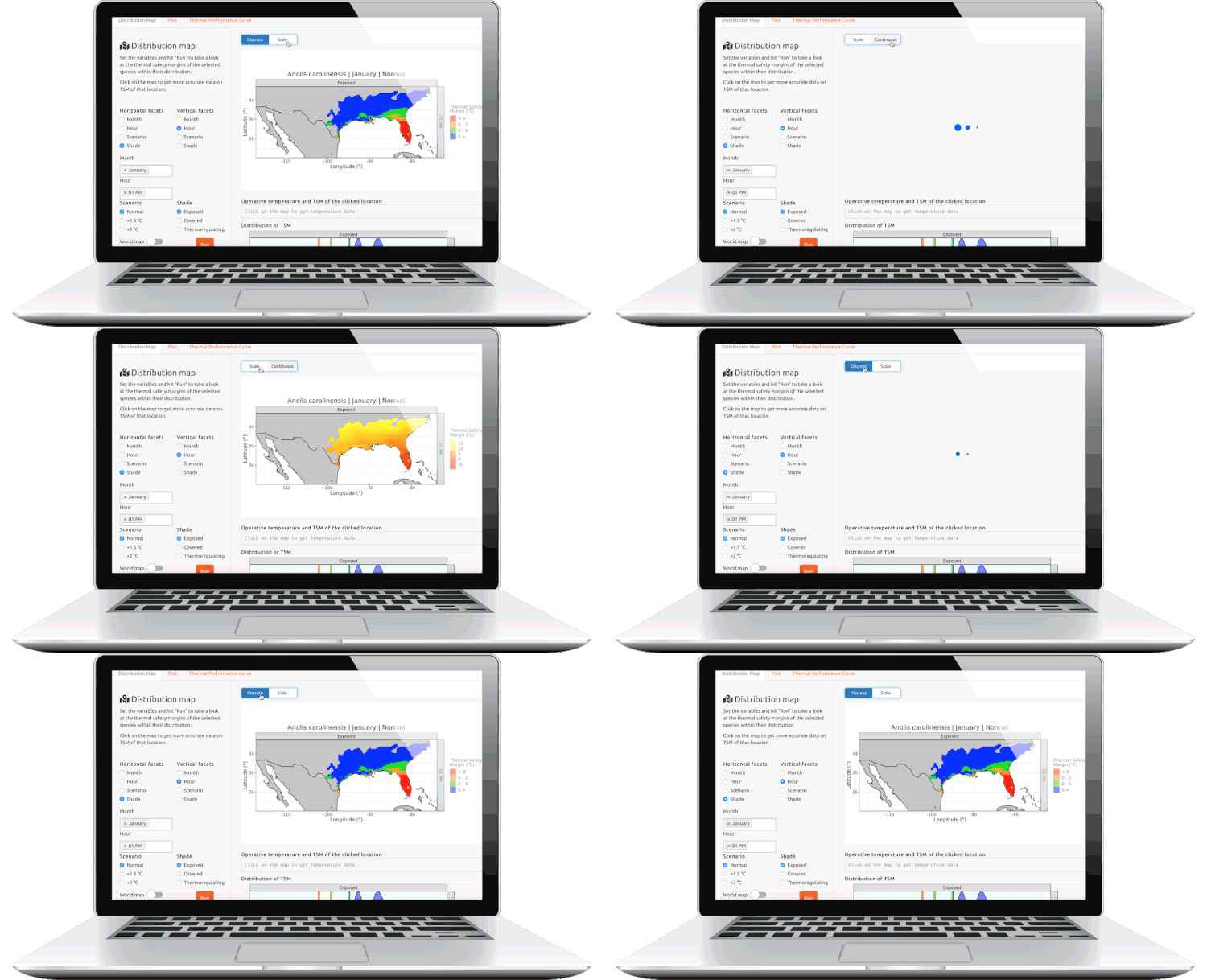
We created interactive visualizations for exploring organismal responses to environmental conditions. We are not currently running the server with the mapping applications, but the visualizations are offered in GitHub.
Mapping ectotherm body temperatures and areas of thermal stress: The app uses biophysical models for a variety of ectothermic taxa to map recent and projected future body temperatures and areas of thermal stress across the US.
Lizard thermal safety margins: The app uses biophysical modeling to explore lizard body temperatures and thermal safety margins — how much warming could occur before a lizard exceeds its thermal tolerance.
Insect development and phenology: The app leverages a database of insect development traits to predict phenology for many species across the US.
Project-specific tools
Extreme value analysis for temperature data
Code for a review paper on quantifying thermal extremes.
Code from a perspective paper on leveraging organismal biology to forecast the effects of climate change.
Model of butterfly responses to climate change
Code for a model tntegrates microclimate, developmental, biophysical, demographic, and evolutionary models.
THE WHY BEHIND OUR WORK
New climate challenges demand new tools.
We provide computational and visualization tools that can improve our climate change models by (1) extracting fine spatial and temporal scale microclimate data, (2) translating microclimate conditions into animal body temperatures, and (3) mapping body temperatures and regions of thermal stress.