TrEnCh Project
INFRARED IMAGERY
Seeing the world from a thermal perspective
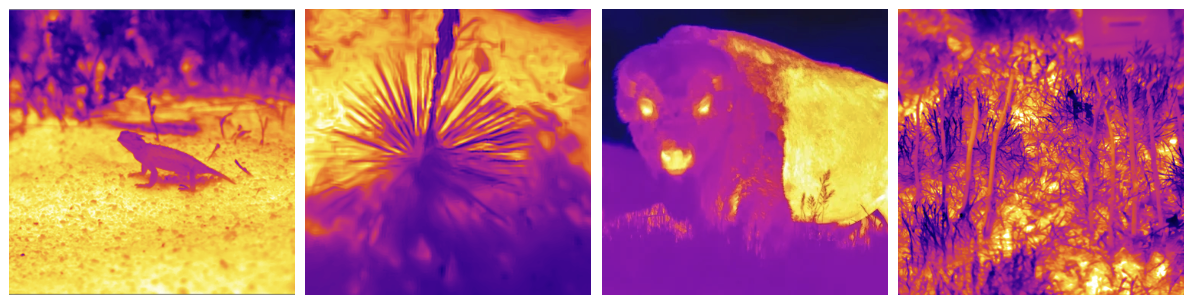
Infrared imagery offers a unique opportunity to see biophysical properties in real time. We can watch organisms heat up, cool down, and generally transfer heat back and forth throughout their environment. In the TrEnCh Project, we use infrared imagery to help people see the world from a thermal perspective because we believe it’s an intuitive first step to understanding microclimate and the impacts of warming.
Scroll down to learn how you can participate ▼
What infrared images are telling us →
#1: Real-time data on thermal conditions
Infrared images show us heat in an environment. Warmer colors, like orange, yellow, and red, indicate higher temperatures. Cooler colors, like green and blue, indicate cooler temperatures.

#2: Insight into thermal processes
Thermal images help us ask and answer questions about heat transfer in an environment. We can watch organisms gain and lose heat, providing insight into the thermal processes underlying the patterns we see.
#3: Implications of warming
Finally, infrared images help us see when temperatures exceed what an organism can tolerate. We can watch body temperatures rise and notice when they reach a critical threshold. This helps us identify concerns for conservation.
TrenchIR: processing and serving InfraRed imagery
FLIR cameras often produce images in a non-standard format (radiometric jpgs) and analyzing the images requires purchasing expensive FLIR software. Learn about how convert IR images into standard image formats (like jpegs and pngs) and access images for research, education, and outreach at TrenchIR.
Our goal is to empower more people to view the world from a thermal perspective.
Bringing infrared imagery to Instagram
As part of the project, we share infrared cameras that attach to smartphones, to encourage project members to explore the thermal conditions of their own environment. Let us know if you’d be interested in participating!
Follow us on Insta @trenchproject for images exploring the thermal complexities of everyday life.
Guidelines for our Instagram account:
We want to highlight the thermal complexities of nature. Examples include landscapes with variation in sun and shade or different types of surfaces. Animals and plants showing thermal variability or seen in thermally variable landscapes are perfect. Objects and people are okay too, if aligned with the goal of helping students and the public understand why temperatures vary and how that might influence thermal stress and sensitivity to climate change. Any style and length of caption is fine. For education purposes, it’s best to describe the thermal variation and why it occurs.
How to get your images featured on our account:
We create most of our images using an inexpensive FLIR ONE camera attached to a smart phone. The camera’s hybrid visual IR images can facilitate interpretation over traditional IR cameras. FLIR ONEs are also easier to carry around than a traditional IR camera. However, images from any IR camera are welcome.
To have your IR image featured on our Instagram account, tag us in your photo @TrEnChProject. We welcome images that can be paired with IR images to aid interpretation.
Please get in touch with us if you have images you’d like to contribute or if you’d like to borrow an IR camera to take images to share with the account. If you’d like to contribute, you can upload to TrEnCh-IR, post directly to the Instagram account, or we’ll provide a Google Drive folder for you to upload your images to, so we can post on your behalf.